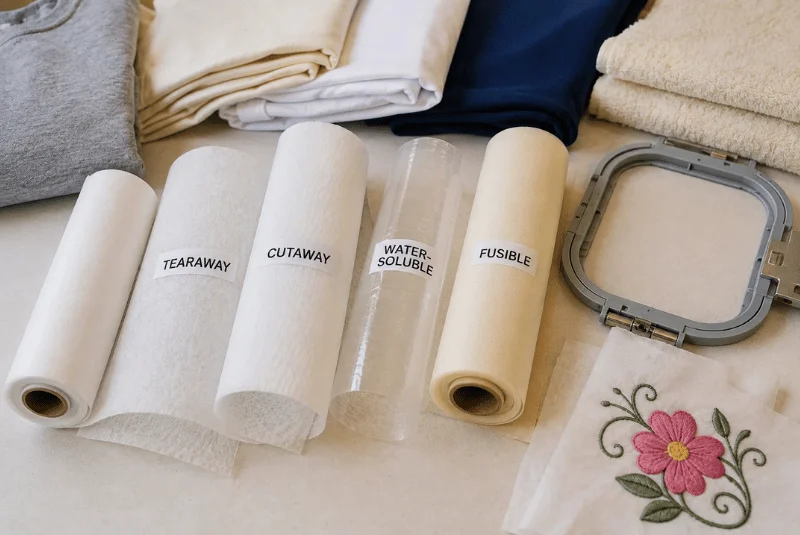
The right stabilizer is chosen by matching it to your fabric and design: the fabric determines the type of stabilizer, and the design determines its weight. Use cutaway for stretchy knits and dense designs, tearaway for stable woven fabrics, water-soluble for lace and sheer fabrics, and fusible for delicate materials.
Choosing the right stabilizer is one of the most crucial things, and the fabric determines the type of stabilizer and the design determines the weight. It falls beneath a simple rule: the fabric determines the type of stabilizer, and the design determines the weight. Whereas, one should always match the heavy stabilizer with heavy fabrics, pair dense designs with heavier backings, and pair lightweight, airy patterns with thinner and softer backings.
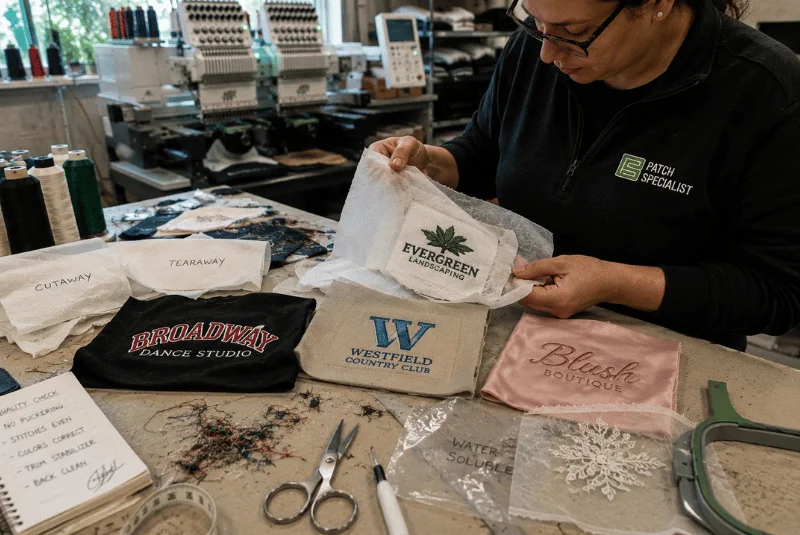
From the initial puckering to the distortion and shifting of the stitches and poor registration, many embroidery issues stem from the wrong selection of backing, rather than just poor digitizing.
Due to this concern, it's important to understand the relationship between your fabric, design, and stabilizer for achieving professional embroidery results.
In this blog, we will explain how to choose the right stabilizer for your digitized designs, compare cutaway vs tearaway stabilizers, explore specialty options like water-soluble stabilizer and fusible stabilizers, and discuss how you can achieve the right fabric and stabilizer match for successful embroidery.
A good quality stabilizer offers temporary support for the fabric during the embroidery as thousands of stitches penetrate the material, and the stabilizers prevent stretching, shifting, and puckering while maintaining the design accuracy.
Without adequate support, designs may appear distorted despite perfect digitizing. This is why experienced digitizers and digitizing companies tend to consider the right stabilizer for embroidery digitizing before the machine starts stitching.
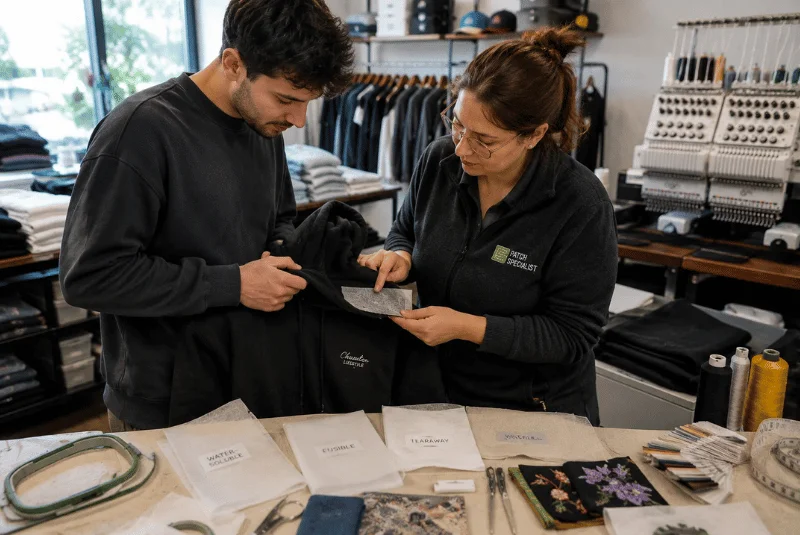
Not even a single stabilizer works for every embroidery design. You may require different stabilizers to deal with various fabrics, as they will respond differently under the stitch tension, making the fabric and stabilizer match a necessity.
Perhaps, while selecting a stabilizer, it's necessary to choose:
Professional digitizers say matching the stabilizers to the fabric ensures cleaner embroidery, improved stitch registration and longer-lasting results.
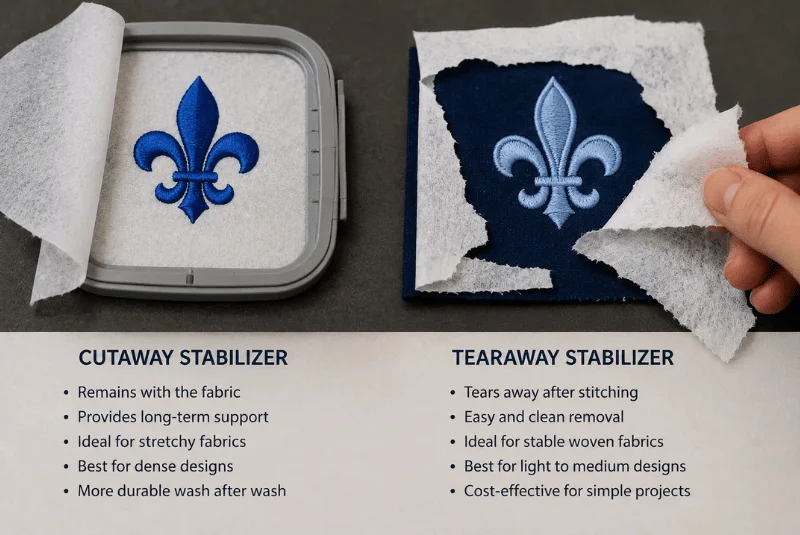
You will see digitizers mostly quarrel over this - cutaway vs tearaway stabilizer, which one is the best? Both serve important purposes, but choosing the wrong one can negatively affect embroidery quality. For text-heavy work, the Stabilizer for Embroidery Lettering matters just as much as the fabric.
You know, a cutaway stabilizer remains attached to the fabric even after the embroidery, leaving only the excess trimmed away. Hence, a really good approach.
It is best for T-shirts, Polo shirts, Sweatshirts, Stretch fabrics, Knit fabrics, and High-density embroidery. The core advantages include offering instant support to the digitizers, preventing stretching after the embroidery, reducing puckering, and maintaining the design's shape through repeated washing.
Perhaps cutaway stabilizers are the best for garments that actually require frequent movements and washing because they might continue to support the stitching throughout the garment's lifespan.
A tearaway stabilizer is removed from the embroidery even by gently tearing it away from the stitched design. Hence, it doesn't require any excessive effort like cutaway stabilizers. It is best for woven fabrics.
It is best for Towels, Caps, Aprons, and Lightweight decorative embroidery.
It offers easy removal, faster finishing, a clean appearance on stable fabrics, and cost-effectiveness for simple designs.
Here is the quick comparison between the two major selections:
| Cutaway | Tearaway |
|---|---|
| Fabric stretches | Fabric is stable |
| Design has high stitch density | Design is lightweight |
| Durability is important | Easy backing removal |
| Garments will be washed frequently | Decorative rather than structural support |
You may use a water-soluble stabilizer that dissolves in water after embroidery, leaving no visible backing behind. Whereas cutaway or tear-away stabilizers are designed for situations where visible backing would negatively affect the final appearance.
The best applications include freestanding lace, organza embroidery, sheer fabrics, tulle, decorative edging, and lace applique.
Now let's learn about the benefits of fusible stabilizer:
Fusible stabilizer comprises a heat-activated adhesive that temporarily bonds the stabilizer to the fabric. Whereas, it also adds stability to help prevent the fabric from shifting during hooping and embroidery. A firm backing also helps as a Stabilizer for 3D Puff Embroidery, where raised foam needs a stable base.
Fusible stabilizers are ideal for:
Successful digitizing for unstable fabrics requires adjustments that go beyond simply choosing the correct stabilizer. Digitizers mostly apply underlay stitches, pull compensation, stitch density, stitch direction, and stitch sequencing.
Professional digitizers always consider how the fabric behaves before determining stitch settings. The same care applies when picking a Stabilizer for Photo Embroidery, where dense detail needs firm support.
Choosing the right stabilizer for embroidery digitizing has become one of the easiest tasks when you follow general recommendations:
The quality of an embroidery design depends entirely on the stabilizer and the digitizer's experience. Understanding the core difference between cutaway and tearaway would help you make the right choice. Applying a fusible stabilizer for delicate materials and achieving the right fabric match would be great. Successful digitizing for unstable fabrics requires thoughtful stitch adjustments combined with appropriate stabilization techniques. Choosing the right stabilizer would reduce puckering, improve stitch accuracy, and extend garment durability with consistency, offering high-quality embroidery that looks professional and holds up after multiple washes.
Choosing the right stabilizer comes down to one simple idea: match it to your fabric and your design. The fabric decides the type of stabilizer, while the density and size of your design decide its weight.
Cutaway keeps stretchy knits and dense designs stable, tearaway gives stable woven fabrics a clean and quick finish, water-soluble disappears for lace and sheer work, and fusible supports delicate materials during hooping. When you pair the backing correctly and adjust your digitizing for how the fabric behaves, you get embroidery that stays crisp, holds its shape, and looks great wash after wash.
Customer satisfaction is our top priority. Feel free to contact us for any queries or assistance. Looking forward to serving you with our top-notch design services
Here are the key factors to follow before choosing the right stabilizer for your embroidery:
The three main categories are Cut-Away, Tear-Away, and Wash-Away stabilizers, and selecting the right one depends primarily on your fabric's stretch and the design type.
Cutaway stabilizer stays attached behind the fabric for lasting support, making it ideal for stretchy knits and dense designs, while tearaway stabilizer is gently torn away after stitching and works best on stable woven fabrics.
A cutaway stabilizer is best for stretchy and knit fabrics because it stays in place and prevents the fabric from stretching or puckering during and after embroidery.
Yes, you can combine stabilizers when needed, such as using a tearaway backing with a water-soluble topping on towels, to get both support underneath and a clean finish on top.
Already have an account? Login